
British dishes for tourists British food has spent decades living under an unfair reputation. Ask someone from North America or continental Europe to describe British cuisine and they will often reach for words like “bland,” “boiled,” or “beige.” Those people have clearly not eaten well in Britain — because the reality is something else entirely.
The United Kingdom is a country of four nations — England, Scotland, Wales, and Northern Ireland — each with its own distinct culinary identity shaped by geography, history, and culture. From the salt-marshes of Wales to the smokehouses of Northumberland, from the curry houses of Birmingham to the afternoon tea rooms of the Home Counties, Britain offers a food experience that is richer, more historically layered, and more genuinely delicious than its international reputation suggests.
If you are planning a trip to the UK in 2026 — whether you are flying in from the USA, crossing from Canada, or visiting from elsewhere in Europe — this guide to the essential British dishes for tourists is your starting point. Eat these ten dishes and you will leave understanding Britain considerably better than when you arrived.
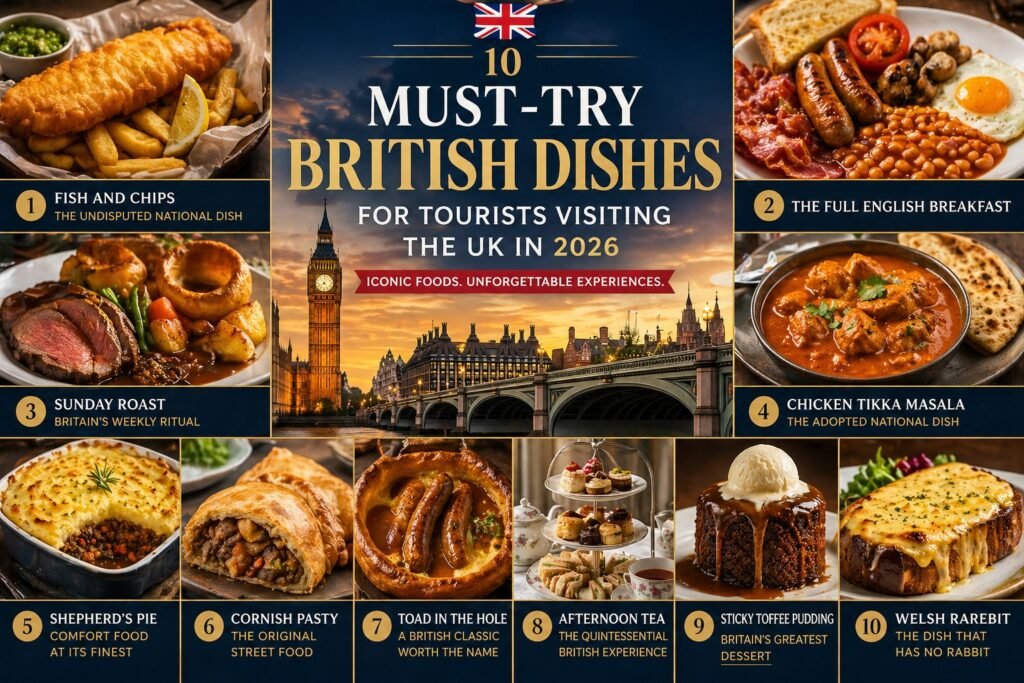
Fish and Chips — The Undisputed National Dish ,British dishes for tourists
There is no more important British dish for tourists than fish and chips. It is the dish that has defined British street food since the first chip shop opened in Bow, East London, in 1860 — and with around 10,500 chippies still operating across the country, it remains as central to British food culture as ever.
The dish is straightforward: a thick fillet of white fish — usually cod or haddock — battered and deep-fried until the outside is shatteringly crisp and the inside remains soft and flaky. It arrives with chunky chips (never thin-cut fries), a generous dousing of salt and vinegar, and — in the north of England — a side of mushy peas, made from reconstituted dried marrowfat peas cooked to a thick, vivid green paste that tastes considerably better than it looks.
The golden rule for tourists: avoid the overpriced versions in central London tourist traps. Instead, find a proper chippy on a high street, or better still, eat fish and chips by the sea. Whitby in North Yorkshire and Brighton on the south coast consistently serve some of the finest examples in the country.
Where to try it: Any traditional chippy on a British high street; The Magpie Café, Whitby; The Golden Chippy, Greenwich, London Price: £10–£13 takeaway; £14–£18 sit-down in London
The Full English Breakfast,British dishes for tourists
Known affectionately as a “fry-up,” the Full English Breakfast is Britain’s most substantial morning ritual — and one of the first things every tourist from the USA and Canada should experience. Forget the continental pastry or the protein bar: the Full English is a plate-sized commitment to starting the day properly.
A complete Full English includes fried or scrambled eggs, back bacon rashers, pork sausages, grilled tomatoes, mushrooms, baked beans, toast, and black pudding — a dark, spiced sausage made from pork blood and oatmeal that sounds alarming but tastes remarkably good once you commit to trying it. Everything arrives on a single large plate, usually with a mug of strong builders’ tea on the side.
The Wolseley on Piccadilly in London does a particularly celebrated version if you want to experience the Full English in refined surroundings. For a more authentic, no-frills experience, any traditional transport café or seaside B&B will serve one that is just as satisfying at half the price.
Where to try it: The Wolseley, London; any traditional British café or B&B Price: £8–£15 depending on location
Sunday Roast — Britain's Weekly Ritual,British dishes for tourists
If the Full English belongs to weekday mornings, thew Sunday Roast ons the weekend. This is Britain’s great communal meal: roasted meat — usually beef, chicken, lamb, or pork — served with crispy roast potatoes, seasonal vegetables, stuffing, and a generous pour of rich gravy, all anchored by one or more Yorkshire puddings.
Walk past any British pub between noon and 4pm on Sunday and the aroma hits you first: roasting meat, rich gravy, and that indefinable scent of tradition. The Sunday Roast endures as a weekly institution because it offers something that modern life often lacks — a designated reason for people to gather, slow down, and share food without distraction.
For tourists, the Sunday Roast is an unmissable cultural experience as much as a meal. The best versions are found not in city centre restaurants but in traditional country pubs, particularly in the Yorkshire Dales, the Cotswolds, and the villages of rural England. One practical note: do not ask for a Sunday Roast on a Tuesday. You will be gently but firmly corrected.
Where to try it: Traditional British pubs, particularly in rural England; The Harwood Arms, Fulham, London Price: £14–£22 in London; £12–£18 elsewhere
. Chicken Tikka Masala — The Adopted National Dish
It may surprise visitors from the USA and Canada to learn that one of the most British dishes you can order in the UK is a curry. Chicken Tikka Masala — yogurt-marinated chicken in a rich, spiced tomato and cream sauce — was for 23 consecutive years voted Britain’s most loved national dish, only recently replaced at the top of the rankings by fish and chips.
One result of Britain’s nearly 200-year connection with India is a deep love of curries, dals, tandoori, and other Indian flavours. Indian restaurants are found on virtually every British high street, and the quality is frequently extraordinary. Birmingham’s Balti Triangle and Bradford’s curry quarter — known as the curry capital of England — are the best destinations for serious curry tourism, though London’s Brick Lane and Dishoom’s various London locations are excellent starting points for first-time visitors.
Where to try it: Dishoom, multiple London locations; the Balti Triangle, Birmingham; Bradford curry houses Price: £10–£15 for a main course
Shepherd's Pie — Comfort Food at Its Finest
Few dishes capture the essence of British home cooking quite like Shepherd’s Pie: a deep dish of slow-cooked minced lamb in a rich gravy, topped with a golden, creamy layer of mashed potato and baked until the top is bronzed and slightly crisp at the edges. It is the kind of food that makes cold, grey British weather feel like a reasonable trade-off.
A true Shepherd’s Pie must contain lamb — since shepherds tend sheep — while Cottage Pie uses beef. The distinction matters to anyone who grew up in Britain, even if restaurant menus increasingly blur the two. Both versions date back to the late 18th century, born of the practical need to use leftover roasted meat and make it stretch further. Today, Shepherd’s Pie is a pub and gastropub staple found across the entire country, and is one of the most satisfying British dishes for tourists to try in colder months.
Where to try it: Any traditional British gastropub; particularly good in rural England during autumn and winter Price: £12–£18
Cornish Pasty — The Original Street Food
Long before food trucks arrived in British cities, Cornish miners in the 18th and 19th centuries were carrying their lunch underground in the form of a Cornish pasty — a D-shaped shortcrust pastry case crimped along the top, filled with beef, potato, swede, and onion, seasoned simply with salt and pepper.
The pasty’s thick crimped edge was originally designed to be held and discarded after eating, preventing miners from contaminating their food with arsenic-covered hands. Today, the Cornish Pasty holds Protected Geographical Indication status, meaning only pasties made in Cornwall can be officially called Cornish. For tourists visiting the West Country, eating a proper Cornish pasty fresh from a bakery in Falmouth, Truro, or St. Ives is a genuinely memorable experience — and one that costs considerably less than most things on this list.
Where to try it: Any traditional Cornish bakery in Cornwall; Rowe’s Cornish Bakers; Oggy Oggy Price: £4–£7
Toad in the Hole — A British Classic Worth the Name
No list of must-try British dishes for tourists would be complete without at least one dish with a baffling name. Toad in the Hole has been confusing visitors since the 17th century, when the first recorded reference to the dish appeared in print. Despite everything the name implies, no amphibians are involved.
The dish is a one-tray bake in which pork sausages — the “toads” — are cooked in a deep pour of Yorkshire pudding batter, which rises dramatically around them in the oven until golden, crispy on the outside and soft within. Served with gravy, onion sauce, and seasonal vegetables, it is one of the most comforting British dishes imaginable and one that very few restaurants outside the UK attempt to recreate. Finding a good Toad in the Hole in a traditional British pub is its own reward.
Where to try it: Traditional British pubs across England Price: £12–£16
Afternoon Tea — The Quintessential British Experience
Afternoon tea is not quite a dish — it is an institution. Created in the 19th century as a light meal to bridge the gap between lunch and dinner, it has evolved into one of the most beloved British food experiences for tourists from every corner of the world.
A traditional afternoon tea consists of finger sandwiches (cucumber, smoked salmon, egg and cress), freshly baked scones served with clotted cream and jam, and a tiered selection of cakes and pastries — all accompanied by a pot of properly brewed tea. The scone protocol is its own cultural flashpoint: in Devon, cream goes on first; in Cornwall, jam goes on first. Choose your side carefully.
For American and Canadian visitors particularly, afternoon tea offers a window into a very specific strand of British culture — one of ceremony, restraint, and extraordinary attention to small pleasures. London’s Claridge’s, The Ritz, and Bettys in Yorkshire are among the most celebrated destinations.
Where to try it: Claridge’s and The Ritz, London; Bettys, Harrogate and York Price: £50–£80 per person at top venues; £20–£35 at high street tea rooms
Sticky Toffee Pudding — Britain's Greatest Dessert
Ask a room full of British people to name their favourite dessert and sticky toffee pudding will dominate the vote. This dense, moist sponge cake made with finely chopped dates is drenched in warm toffee sauce and served — always — with a generous pour of thick cream, vanilla custard, or a scoop of vanilla ice cream melting into the sauce.
The dish is a relatively modern creation, appearing on British menus in the 1970s and associated most strongly with the Lake District in Cumbria, where the Sharrow Bay Country House Hotel claims to have invented it. Whatever its exact origin, sticky toffee pudding now appears on pub menus and restaurant dessert lists across the entire country. For visitors from the USA and Canada unfamiliar with British puddings, this is the one to start with.
Where to try it: Virtually any British gastropub or restaurant with a dessert menu Price: £7–£12
Welsh Rarebit — The Dish That Has No Rabbit
Wales’s contribution to this list is a dish that sounds like it should contain something it absolutely does not. Welsh Rarebit — sometimes spelled “Rabbit” — is, at its simplest, an exceptionally sophisticated cheese on toast: a rich sauce made from strong Cheddar or Caerphilly cheese, melted with butter, Worcestershire sauce, English mustard, and beer or milk, then poured over thick-cut toast and grilled until bubbling and golden.
Welsh cheese on toast is often voted as the best cheese on toast in the world — and once you taste a properly made Welsh Rarebit, the enthusiasm becomes entirely understandable. In London, The Wigmore pub serves a celebrated three-cheese version so large it is designed to share, topped with cornichons and red onion. In Wales itself, any traditional pub or café worth its reputation will have a version on the menu.
Where to try it: The Wigmore, London; traditional pubs throughout Wales Price: £8–£14
Final Thoughts: British Food Is Better Than Its Reputation
The ten British dishes for tourists in this guide represent only a fraction of what the UK’s culinary landscape has to offer. Behind them lies an extraordinary range of regional specialities — Scottish haggis, Cornish saffron cake, Ulster fry, and Welsh cawl — that reward curious visitors willing to venture beyond the obvious. British food has shed its unfair reputation, and 2026 is the perfect year to discover exactly why. Come hungry, keep an open mind, and leave every chippy, pub, and tea room a little happier than when you entered